Industry guides
Know every part you need the day the order arrives
How a bill of materials turns one order for finished goods into a full list of parts, quantities and shortages.
Contents
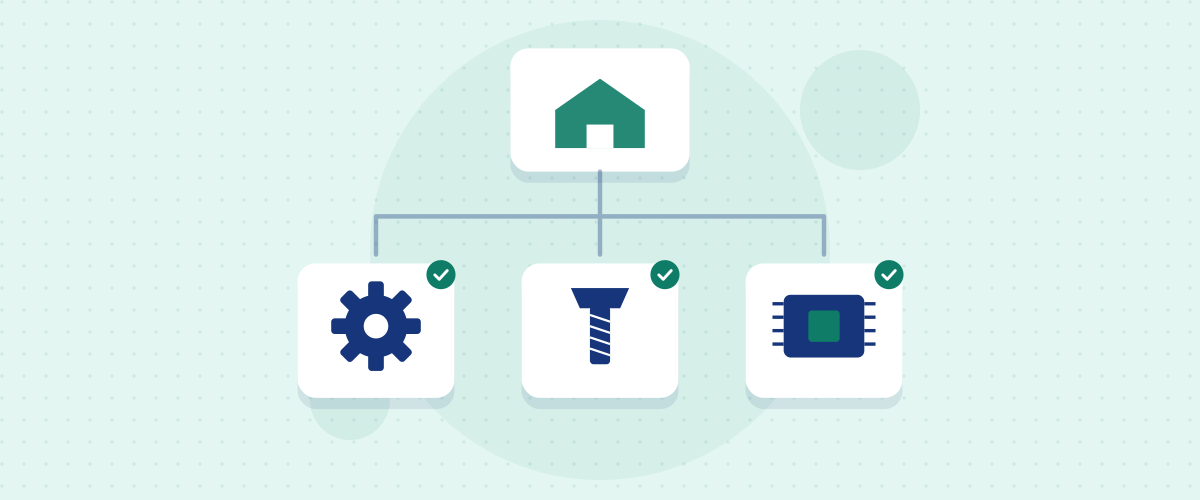
- When you make or assemble goods, one export order can need dozens or hundreds of parts.
- Working out what to buy by hand is slow, and mistakes show up a week before the ship date.
- A bill of materials lets the system list every part and quantity the day the order is confirmed, so buying starts at once.
The shortage you find too late
An order arrives for 200 pumps. Your team knows roughly what goes into a pump. Someone works out the parts on a spreadsheet, checks the store and places orders with suppliers.
Three weeks later, during assembly, a gasket runs out. It was on the list, but the quantity was worked out for an older model. A supplier can deliver in ten days. The ship date is in eight.
Or the opposite: the store already had enough bearings, but nobody checked, and you bought them again.
Both mistakes come from the same place: a parts list worked out by hand, under time pressure.
What a bill of materials is
A bill of materials, or BOM, is the recipe for a product. It lists every part and the quantity needed to make one unit.
A simple example for one pump:
| Part | Quantity per pump |
|---|---|
| Pump casing | 1 |
| Impeller | 1 |
| Motor | 1 |
| Shaft | 1 |
| Bearings | 2 |
| Gasket set | 1 |
| Bolts | 8 |
Each product you make has its own BOM. Once it is set up, it is reused for every order of that product.
What BOM explosion does
"Explosion" just means multiplying it out. When the order for 200 pumps arrives, the system multiplies each line of the BOM by 200:
- 200 casings, 200 impellers, 200 motors, 200 shafts
- 400 bearings
- 200 gasket sets
- 1,600 bolts
Then compare the list with your stock. If you have 150 bearings in the store, you need to buy 250. If you have enough bolts, you buy none.
The result, on the day the order is confirmed, is a clear list: what you need, what you have and what you must buy.
From shortage to purchase order
The list is only useful if it turns into orders quickly. Your buyer picks the parts to order, chooses a supplier for each and raises the purchase orders. Each purchase order stays linked to the export order it serves.
That link matters. You can see which parts for this export order are already on order and which are not, and what the parts actually cost. When a buyer changes the quantity, you can see which purchases are affected.
Keeping BOMs right
A BOM is only as good as its last update. Make one person responsible for each product's BOM, and update it whenever the design or a part changes. A wrong BOM repeats the same mistake on every order.
How Expodite helps. In Expodite, a product can have a bill of materials. When the export order is confirmed, Expodite lists every component and quantity on a worklist. When you raise a purchase order, it can show the stock you already hold and suggest buying only the difference. Your buyer selects the rows, picks a supplier and creates the PO, which stays linked to the export order.
See bill of materials and back-to-back ordersQuestions to ask your team
- How long does it take us today to work out what to buy for a new order?
- Where are our product recipes kept, and who updates them?
- When did we last find a shortage during assembly or packing?
- Have we bought parts we already had in stock this year?
- For our current orders, which parts are still not ordered?
Quick answers
- What is BOM explosion?
- Multiplying a product's bill of materials by the order quantity to get the full list of parts and quantities needed, usually checked against stock to show shortages.
- Do merchant exporters need a bill of materials?
- Usually not for goods they buy finished. It matters when you make, assemble or kit products from parts.